
Printed Area Rugs vs. Axminster: A Hospitality Tender Comparison
Print carpet vs Axminster for hospitality — the real differences that decide a tender: gradients vs woven depth, matt and gloss zones, marine certification, density and lead time.
The reflex in most hotel briefs is simple: Axminster for premium, print for budget. It is also wrong. Both are contract-grade, both run in similar lead times, and both carry far more colour than most schemes use — so neither cost nor palette is what actually separates them.
What separates them is what the design needs and where the carpet has to perform. Soft gradients or woven depth. Matt and gloss in the same floor, or not. A marine certificate, or not. Get those constraints on the table and the technique almost picks itself.
01It Is Not a Quality Question
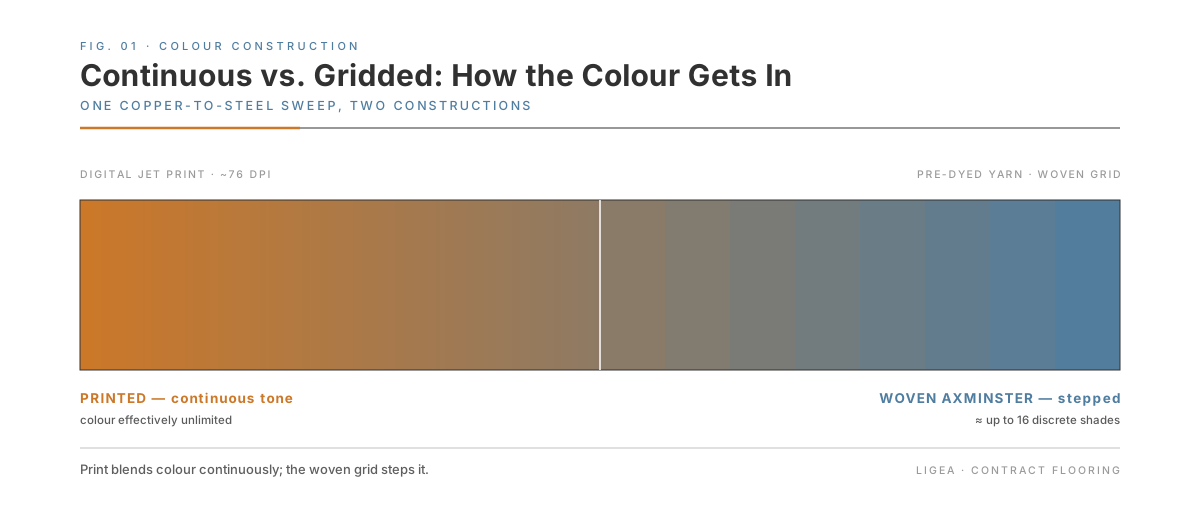
Both techniques are built for hospitality and both clear the fire and emissions certificates a hotel project needs. And colour count rarely decides it: a modern Axminster loom reaches around sixteen colours per design, while a digital print line works from a continuous-tone, pre-mixed palette with a far wider practical range. Both carry more colour than most schemes need, so palette seldom forces the choice.
The real differences are about how the colour gets into the carpet, and what each construction can and cannot do.
02When Axminster Wins
Axminster is woven from yarn that is dyed before it goes on the loom. The colour runs all the way to the base — so the field reads deep and even, and the surface looks genuinely woven, which is exactly what a woven brand standard expects.
- Matt and gloss in one design. Because it is built from yarn, Axminster can place matt zones (an 80/20 wool-nylon) next to gloss zones (100% nylon) within the same floor — sheen sculpted into the pattern. A printed roll has one uniform base sheen; it cannot zone it.
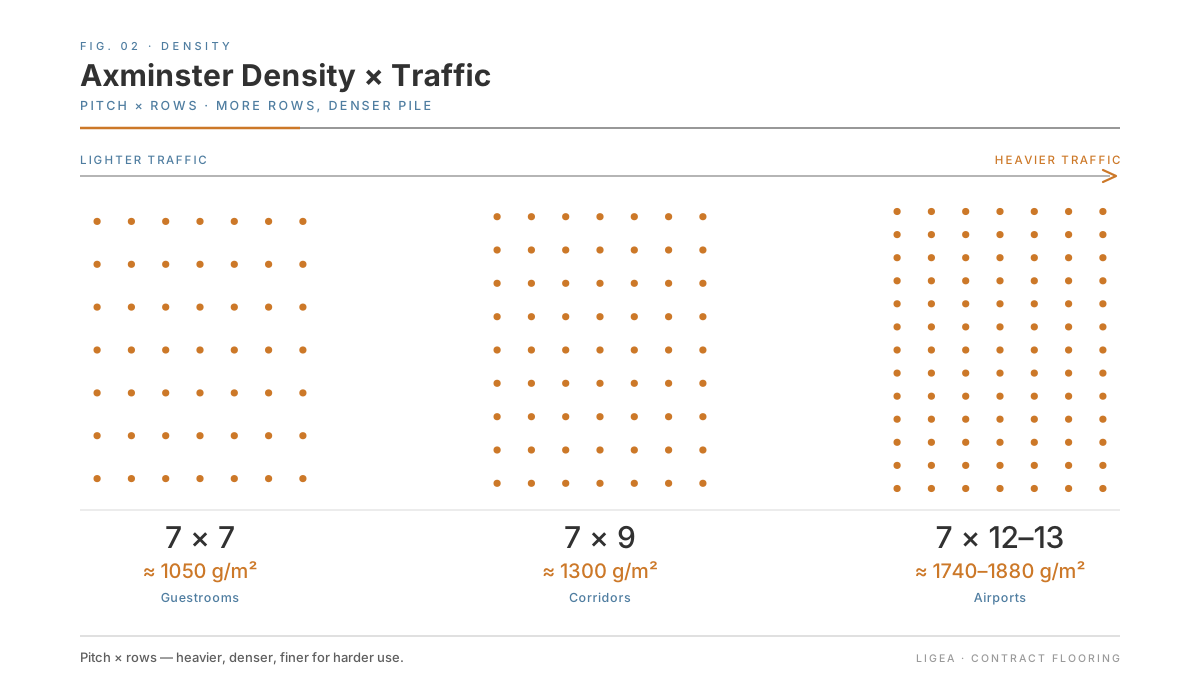
- Density tuned to traffic. Axminster is specified by pitch × rows (pitch across, rows along — the woven counterpart of tufting gauge), and the row count is a durability dial. It runs from 7×7 (≈1050 g/m²) for guestrooms, through 7×9 (≈1300 g/m²) for corridors and busy public areas, up to 7×12 or 7×13 (≈1740–1880 g/m²) for the heaviest-traffic floors such as airport terminals. More rows mean a tighter, denser, more hard-wearing — and finer — surface, set per area.
- Longevity. Because the yarn is pre-dyed and locked into a woven structure, the colour stays true as the carpet wears (it runs through the pile rather than sitting on top), and the pile is anchored mechanically by the weave rather than by an adhesive bond the way tufted backing is. Delamination, the adhesive bond failing, is largely a cheap-production issue today: quality latex compounds and proper curing keep it rare and it can be specified against (ASTM D3936 delamination strength), but woven simply carries no such bond to fail in the first place. Well-specified woven floors are widely credited with a 15–25-year physical life, with top-end care programmes stretching toward 30, though in branded hotels the 5–7-year soft-goods cycle usually replaces carpet long before the material gives out. A durability investment, not just a look.
- Marine and cruise. Marine interiors are gated by fire performance, not by weave: under the IMO FTP Code a carpet qualifies by passing the fire, smoke and toxicity tests, and both woven and printed carpets are certified and used at sea. Where Axminster pulls ahead is that its wool-rich construction reaches the marine fire classes readily — and the higher European class (EN 13501-1 Bfl-s1) more easily than a synthetic print — which is why it remains the long-standing cruise and yacht choice.
- The trade-off — resolution is gridded. Because the colour sits in discrete dyed yarns, the design resolves on a grid: a 7×7 reads coarser, a 7×13 noticeably finer (more rows buy resolution as well as durability). But even at the finest pitch, soft gradients step rather than blend — smooth, atmospheric colour transitions are not what the loom is for.
03When Print Wins
Two things usually push a brief towards print — and the first is often simply money.
- Cost. Print is typically the more economical route: there is no yarn to dye colour by colour, and the set-up is simpler, so it tends to be the default for budget-led briefs and large repeat areas. In practice it is often the first reason print is on the table at all.
- Gradients, blends and soft focus. Digital jet printing lays colour continuously, so gradients, blurred transitions and painterly, atmospheric motifs come out smooth — exactly the soft designs where Axminster's grid looks pixelated. If the intent is painterly rather than graphic, print holds it. (Its colour is continuous-tone and works from a far wider pre-mixed range — so if anything print has more colour freedom than the loom's roughly sixteen.)
- Photographic detail — sharpness versus pile. Print can carry richly detailed, even photographic designs on hard-wearing carpet. The real tension is resolution against pile: carpet printing is relatively coarse (around 76 dpi), and pile is yarn — so the crispest photographic detail reads best on a finer, lower pile, while a richer, taller pile feels more luxurious underfoot but softens the image. The craft is choosing the level of realism the floor actually needs, and the pile that carries it.
- Pile and weight set the quality. Printed carpet spans a wide range of weights — from roughly 450 g/m² up to 1400–1650 g/m² at the top — and the heavier weights carry more pile, taller and fuller underfoot. That pile is most of the felt quality difference, and it is the dial you set for traffic and hand.
- Speed, scale and no repeat. Because nothing is dyed yarn-by-yarn, print skips the dyeing stage — typically a step faster than weaving, and that compounds across hundreds of guestrooms. It can also carry one large-scale design with no visible repeat across an entire corridor, where the loom traditionally works in a fixed rapport — though modern Jacquard-driven Axminster looms are closing that gap, so a large-format non-repeat is now a difference of degree, not a hard technique boundary.
- The trade-off. Surface-printed colour sits nearer the surface than woven, so under the heaviest, longest wear it can soften sooner; and a printed roll cannot zone matt against gloss.
04Lead Time — Both Fast, One a Step Faster
Print typically runs roughly 2–4 weeks of bulk production, against roughly 3–8 weeks for Axminster — print is usually the quicker of the two because it skips yarn dyeing. Two caveats carry over from any carpet programme: these are bulk-production times — the clock starts once design, colours, strike-offs and mockups are signed off — and the approval rounds beforehand are real, though they are exactly where AI-assisted rendering and recolouring compress the cycle. Hand-tufted (10–16 weeks) stays reserved for signature pieces, not standard floors.
05Format and Finish
Both techniques come in more than one format: broadloom rolls (3.66 or 4 m wide), cut-and-bound area rugs, and modular carpet tiles. The same design can therefore run wall-to-wall down a corridor, sit as a loose rug in a suite, or go down as tiles in offices and back-of-house — useful wherever areas are replaced piecemeal.
Where a rug is cut from broadloom, the binding is where quality quietly shows. Most of the market finishes with a cheap overlock, and you can see it: it reads as a machine carpet. A proper edge binding — a tape applied to the back — gives a refined, considered edge. On a luxury floor the edge is where the eye lands: it is the difference between a cut piece of broadloom and a made rug.
06The Decision, in One Pass
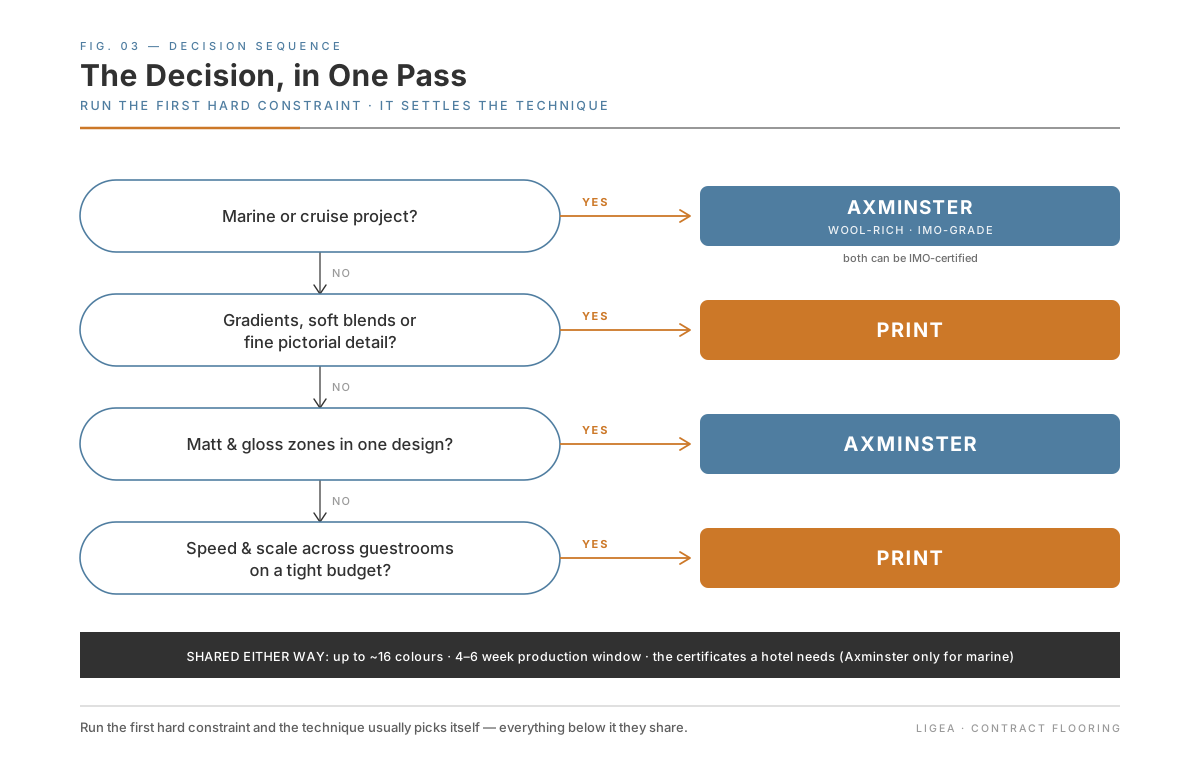
Run the first hard constraint and it usually settles the technique:
- Marine or cruise project? → Wool-rich Axminster is the established marine-grade choice (though both constructions can be IMO-certified).
- Gradients, soft blends or fine pictorial detail? → Print.
- Matt and gloss zones in one design? → Axminster.
- A woven brand standard, or deep even colour? → Axminster.
- Speed and scale across guestrooms on a tight budget? → Print.
Everything else they share: up to sixteen colours and the certificates a hotel needs (with Axminster the only one for marine) — bulk production is the one place they differ, roughly 2–4 weeks for print against 3–8 for Axminster.
07Where ligea Comes In
You should not have to hold all of this yourself — the pitch-and-rows for the traffic, the matt-and-gloss play, the construction that passes marine, the gradient only print carries, the format, the budget, and the edge that makes a floor read as a made rug rather than a remnant — all while wading through catalogues.
That is our job, and we are not tied to one loom or one print line. We read the designer's vision, work to the developer's budget, and match the brief to the right construction and producer — woven or printed, broadloom, rug or tile, at the right pitch-and-rows for the traffic. For cruise and marine we specify wool-rich, IMO-grade Axminster; for soft, painterly or budget-led work, print. And we finish with a proper edge binding, not an overlock. One partner, brief to delivery.
---
ligea engineers contract surfaces for hospitality projects worldwide — woven, printed, hand-tufted and braided, matched per brief to the right technique, certification and budget. If you're weighing print against Axminster on a live tender, see our surfaces or book a 15-minute spec call.