
Casino Carpet: Bold Design Meets 24/7 Durability
Why casino carpet is woven, dense and deliberately busy — the construction, fire, anti-static and cleanability numbers behind round-the-clock gaming floors, plus the psychology myth, for designers and FF&E buyers.
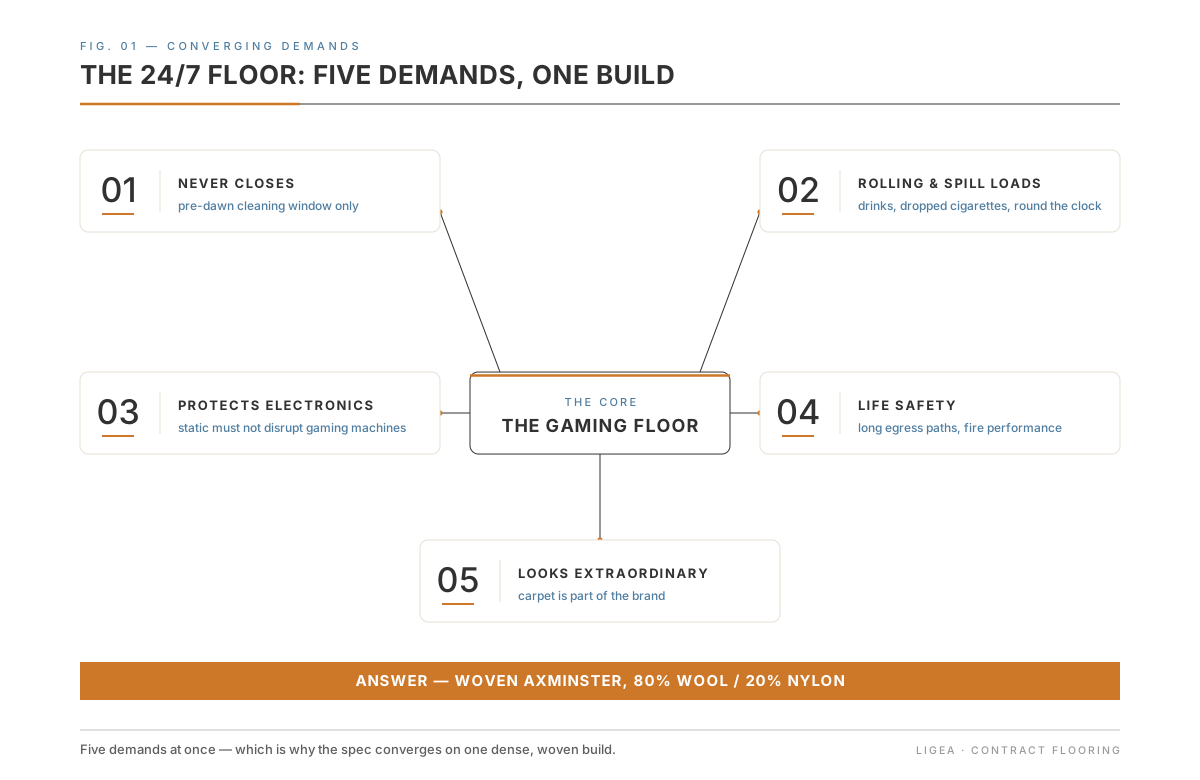
There is no harder floor to specify in hospitality than a casino gaming floor. It never closes, so the maintenance window is measured in pre-dawn hours, not days. It carries rolling loads, spilled drinks and dropped cigarettes around the clock. It hides delicate gaming electronics that static can disrupt. And it has to do all of this while looking, frankly, extraordinary — because the carpet is part of the brand and part of the experience. Get the specification wrong and you are tearing it out inside two years; get it right and it performs for a decade while masking everything the floor throws at it. This guide separates the engineering from the folklore so a designer or FF&E buyer can specify with confidence.
01The Construction: Why Casinos Default to Woven Axminster
Walk almost any gaming floor and you are likely standing on woven Axminster, typically an 80% wool / 20% nylon blend — a 2010 trade estimate put the woven 80/20 blend at around 90% of carpet in gaming areas, though that figure traces to a single trade source rather than a formal survey. The division of labour in that blend is deliberate: wool carries resilience, appearance retention and natural fire performance, while the nylon adds abrasion resistance and tensile strength. Static control comes mainly from wool's natural moisture handling and, where specified, a conductive or anti-static fibre — not from ordinary nylon, which is itself relatively static-prone.
The reason it is woven rather than tufted is structural. In Axminster weaving, the pile is mechanically locked into the weave structure itself at the moment it is inserted, rather than depending on an adhesive bond to a secondary backing for its hold, so a 24/7 gaming floor never has to manage that bond at all. Delamination, the adhesive bond failing on tufted goods, is today largely a cheap-production and ageing issue rather than a defining flaw of tufted construction: quality manufacturers work with latex compounds engineered for exactly this, which all but eliminates the problem, and it can be specified against directly (delamination strength to ASTM D3936). Woven simply removes the variable instead of managing it, which is worth something on a floor with no maintenance window to catch it early. Woven Axminster still carries a thin latex coating on the back, standard on essentially all modern commercial Axminster, for edge-fray protection and dimensional stability rather than because the pile depends on it, a markedly lighter treatment than the structural latex-and-secondary-backing sandwich tufted carpet relies on for its hold. Woven Axminster is commonly credited with markedly longer service lives than tufted in equivalent traffic.
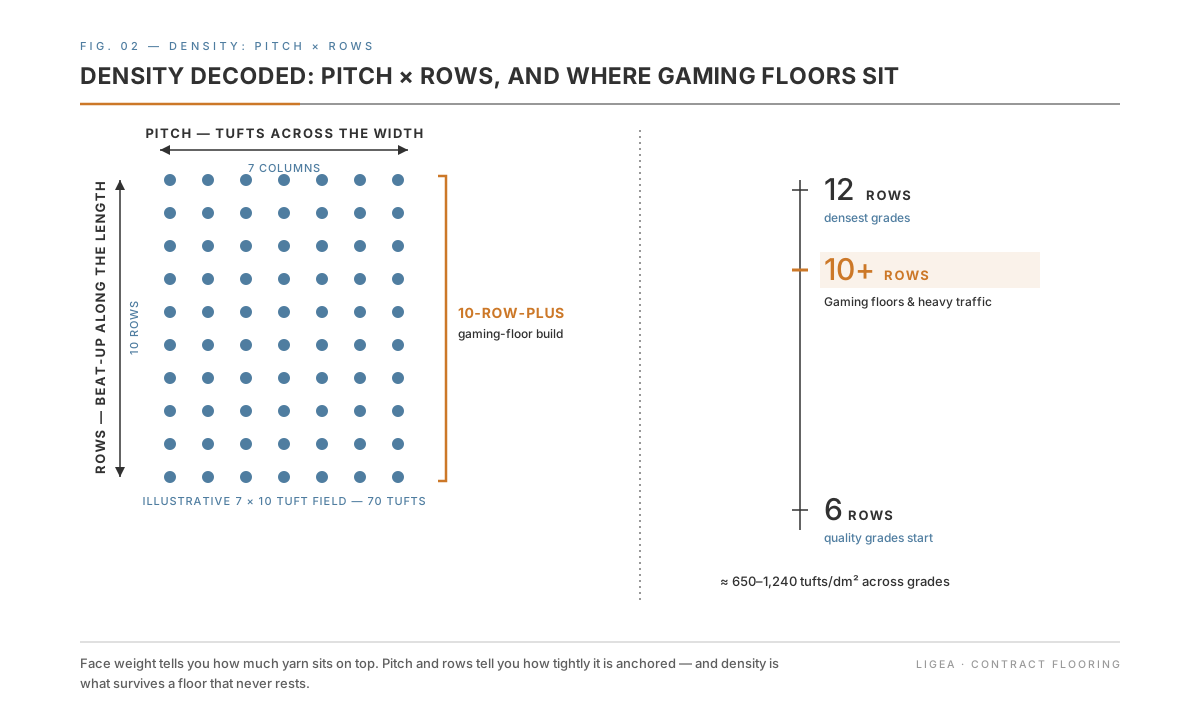
Density is where the specification gets sharp. Axminster is defined by pitch (tufts per inch across the width) and rows (the "beat-up" along the length); quality grades start around six rows per inch and climb to twelve, with tuft densities running roughly 650–1,240 tufts per dm². For gaming floors and other heavy-traffic areas — and wherever crisp pattern definition matters — the guidance is to specify 10-row-plus construction. Woven Axminster broadloom is typically supplied in 3.66 m and 4 m widths, with 4.57 m available from some looms.
One useful cost anchor for budgeting conversations: within the casino segment, machine-woven broadloom occupies the middle tier — pricier than standard tufted commercial carpet, but a fraction of the hand-made showpieces at the top, an order-of-magnitude spread worth keeping in mind. And here is the counter-intuitive part — casino carpet is usually replaced every 3–5 years not because it has worn out, but because the property is re-theming or refreshing the brand. The floor often outlives the design intent.
02The Psychology of the Pattern (and the Myth Worth Busting)
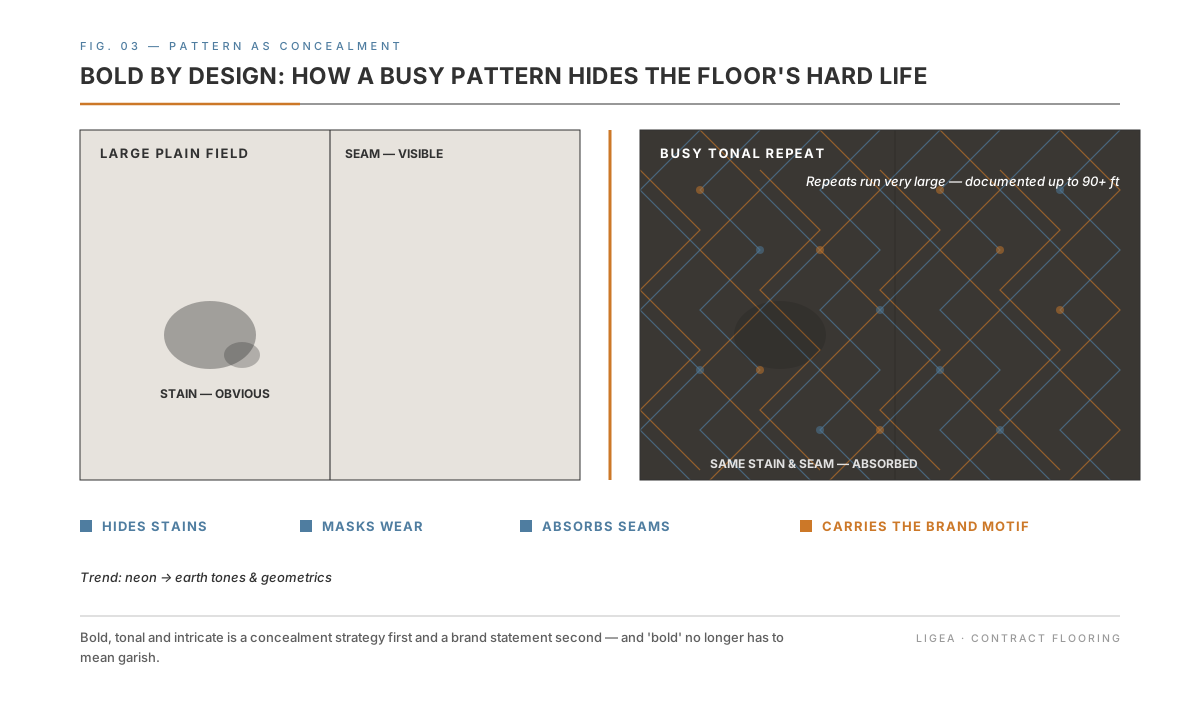
Casino carpet is loud on purpose, and the real reasons are practical before they are psychological. A busy, dark, multi-tonal pattern with no large plain fields hides stains, spills and traffic wear between cleans — vital on a floor that never empties — and it encodes brand identity, sometimes literally, as with motif-driven floors that repeat a property's signature emblem. To keep wear and seams from reading as repetitive, pattern repeats are run very large: trade press reports gaming-floor patterns with repeats of 90-plus feet (Floor Focus).
You will also hear that casino carpet is "deliberately ugly to disorient gamblers and keep them awake." Treat that as folklore. Industry insiders reject it directly — no operator sets out to commission an ugly carpet to manipulate players; bold pattern exists to hide stains, mask wear and reinforce the brand. What is evidenced is gentler: sensory-rich environments produce a degree of cognitive load, and University of Guelph research found that lavish, "playground"-style interiors scored higher on pleasure and restoration than the older cluttered "gaming-first" look (University of Guelph). The design conversation has followed: the trend has moved away from neon brights toward more sophisticated earth tones and geometrics.
For a specifier the takeaway is simple. Bold, tonal and intricate is a maintenance strategy, not a gimmick — but "bold" no longer has to mean garish.
03Fire Performance: Where Wool Earns Its Place
In a crowded gaming hall with long egress paths, flooring fire performance is a life-safety item, not a box-tick. Commercial flooring is rated by critical radiant flux under ASTM E648 / NFPA 253: Class I requires ≥ 0.45 W/cm² (the stricter band, for corridors and slower-evacuation occupancies) and Class II ≥ 0.22 W/cm² for general commercial areas (NFPA). In Europe the parallel system is EN 13501-1, where flooring carries an "fl" suffix and classes such as Bfl-s1 denote strong reaction-to-fire performance with low smoke.
This is the second reason the 80/20 blend dominates. Wool is naturally flame-resistant: it has a limiting oxygen index of around 25–26% (Woolmark), meaning it needs more oxygen than ambient air (≈21%) to keep burning, so it tends to self-extinguish; it chars rather than melts and drips; and it produces comparatively low smoke. Its ignition temperature sits around 570–600°C, against roughly 250–290°C melt points for common synthetics like nylon and polyester (IWTO). On a floor where dropped cigarettes are a daily event, that flame-retardant behaviour also means burns are far less likely to spread or scar permanently — and lower smoke toxicity matters enormously when a fire happens in a packed room.
04Anti-Static and Cleanability: The Two Specs Decks Forget
Two specifications quietly separate a casino-grade floor from a generic hospitality one.
Anti-static is the first. Gaming machines are dense clusters of electronics, and a static discharge from a walking guest is a real nuisance risk. The general commercial benchmark is a body voltage of ≤ 3.5 kV under AATCC Test Method 134 (the "walk test") (CRI). Casino specifications are commonly tighter, with suppliers targeting an anti-static index of ≤ 2.0 kV to protect gaming electronics. One caveat worth carrying into the spec: AATCC 134 measures new carpet, and topical anti-static finishes wear off — so permanent static control built from conductive fibre matters for longevity, not just the opening number.
Cleanability is the second, and it is largely the nylon's job. Solution-dyed nylon has its colour pigment locked inside the fibre before it is extruded, so it resists fading, staining and aggressive cleaning chemistry. That is what makes some constructions bleach-cleanable — a diluted household-bleach solution can lift stubborn spots without colour loss. Wool brings its own resilience — its scaly surface and natural moisture handling resist soiling — but 100% wool stains more readily than bleach-cleanable nylon, which is precisely why the blend, not pure wool, is the gaming-floor standard.
A real-world maintenance note that should shape the spec: casinos cannot close, so cleaning happens in a narrow pre-dawn window. One published case had a crew starting around 4 a.m. with a roughly four-hour window to cover hundreds of thousands of square feet. Low-moisture, fast-drying methods win in that constraint — a reason to confirm a construction's recommended cleaning regime fits the property's downtime, not the other way round.
05Acoustics and the Quiet Performance Win
Carpet's acoustic contribution is modest for airborne sound — typical noise reduction coefficients land around 0.15–0.40 (CRI) — but its real strength is impact noise. Carpet with cushion can add 20-plus IIC points over a hard surface on the same subfloor, with a concrete slab plus carpet reaching roughly IIC 65–75. On a gaming floor stacked above function rooms, hotel suites or back-of-house, that footfall and chair-scrape attenuation is a genuine, if invisible, part of the guest experience — and a reason carpet keeps its place where hard flooring might otherwise tempt a value engineer.
06A Quick Word on Installation
One field reality belongs in any casino brief: on large-repeat patterned goods, pattern match is not guaranteed by the mill, and seams can suffer pattern elongation if the carpet is not handled correctly on site. The industry installation standards treat pattern elongation as a defined defect with stop-work thresholds — a commonly cited rule of thumb is that average elongation beyond roughly 3 inches per 24 feet becomes a call-the-mill condition (CRI installation standards). The practical lesson for specifiers: budget for skilled installation, keep attic stock for plug-repairs in damage-prone zones, and treat the design's repeat size as an installation decision as much as an aesthetic one.
07Where ligea Comes In
The numbers above are industry truth; the value is in translating them to one specific floor. That is the work we do. We read the designer's vision — the bold tonal pattern, the brand motif, the large repeat — and decide which construction will carry it: woven Axminster in 80/20 wool-nylon, specified by the right pitch and row count, where a gaming floor demands density, fire performance and crisp definition; printed nylon where a gradient, soft or photographic scheme needs a very wide colour range. We work to the developer's budget by matching the construction to the zone rather than over-building the whole floor, and by costing on whole-life terms given the 3–5 year re-theming reality. And because we work across multiple producers rather than being tied to a single loom or print line, we can place each requirement — anti-static index, a fire class such as Bfl-s1, a marine-grade variant, bleach-cleanability — with the right line, then confirm colour against your Pantone, NCS or RAL reference with a physical strike-off before anything runs in bulk. Bold design and 24/7 durability are not a trade-off when the brief is matched to the right build.
Explore our surfaces and constructions, or talk to us about a project.