
Carpet Colour Matching: Pantone, NCS, RAL — and Why a Palette Box Limits You
How carpet colour is specified and matched — Pantone TCX vs PMS, NCS, RAL, Sikkens and HKS — and why a manufacturer's fixed palette quietly limits the design.
Open a carpet manufacturer's palette box — a few hundred curated shades on a ring — and a designer's first move is to hunt for the exact colour the scheme is built on. More often than not, it isn't there. The grey is a touch too warm, the green a shade too blue, the off-white reads pink in daylight. That gap — between a fixed palette and the colour the design actually needs — is where a lot of hospitality schemes quietly compromise. They shouldn't have to.
01Why Preset Palettes Exist — and Why They Limit You
A manufacturer's palette is built around what is already easy to run: a set of yarns held in stock, a fixed dye library. It keeps things fast and cheap for the mill, and for a lot of projects it is genuinely enough. But a few hundred presets, however well curated, can never contain every colour a designer might specify — and in a luxury interior colour is rarely "close enough". The floor has to sit exactly against the walls, the upholstery, the stone and the operator's brand palette. Restricting the designer to a palette is, in the end, restricting the design.
There is a quieter consequence too. A house palette is usually a private colour language: its swatch numbers are coded for that one producer and don't translate to anyone else's colour set. Specify a scheme entirely out of a single producer's palette box and the colour record is, in practice, locked to that producer — re-quote it elsewhere and the codes mean nothing, so a like-for-like comparison or a change of supplier becomes far harder than it should be. The way out is to anchor the specification in a neutral, cross-vendor reference rather than one mill's in-house fan.
02The Colour Languages Designers Actually Use
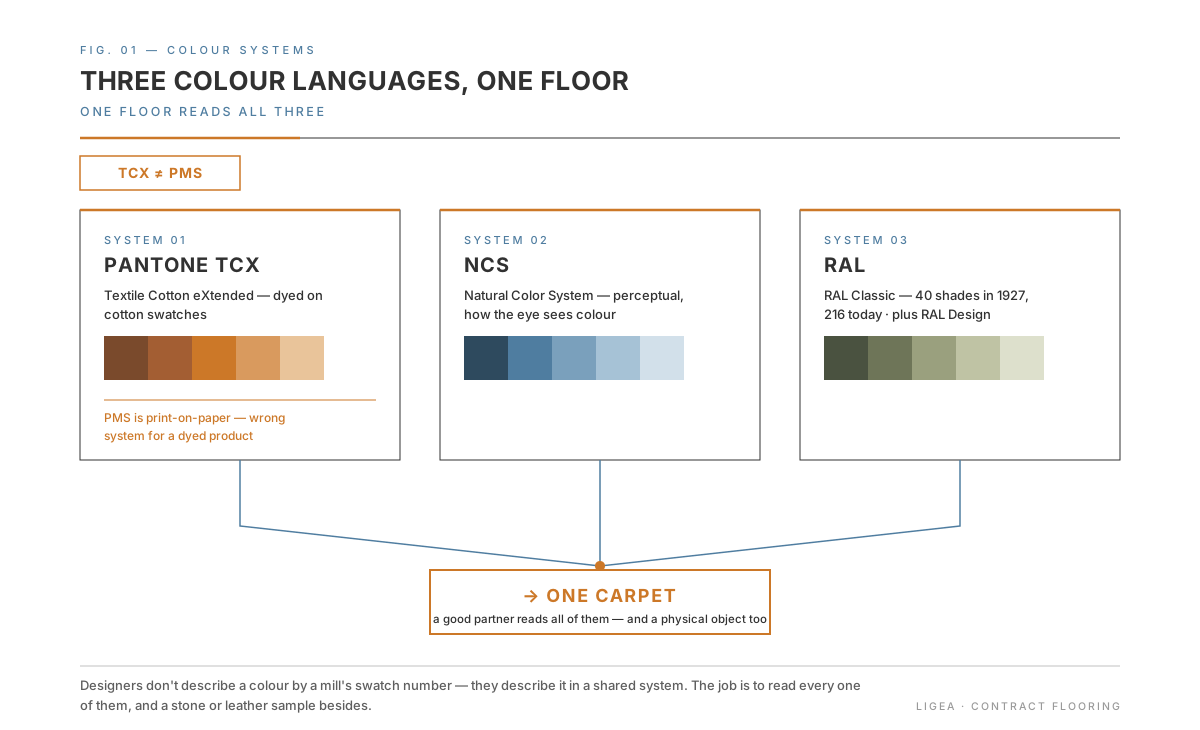
Designers don't describe a colour by a mill's swatch number; they describe it in a shared system. The ones that matter for carpet:
- Pantone — but know which Pantone. Three libraries get loosely called "Pantone", and they aren't interchangeable. PMS (the Pantone Matching System) is the spot-colour standard for print on paper; quoting a PMS print colour for a dyed floor is a common, costly mix-up. For textiles two references matter: TPG ("Textile Paper Green"), the colours on paper, and TCX ("Textile Cotton eXtended"), the same colours dyed on cotton swatches. Our recommendation is to work from the TPG paper guide — almost every studio already has one and it drops cleanly into the usual graphics software, so the colour reference travels with the artwork — while the cotton TCX standard anchors the physical dye match, since paper and dyed cotton can read slightly differently.
- NCS (Natural Color System). A perceptual system based on how the eye sees colour rather than on a pigment recipe — widely used by European architects and interior designers.
- RAL. The European standard: RAL Classic, the numbered colour collection the German RAL body first set in 1927 — 40 colours then, 216 today, alongside the larger, systematic RAL Design — common wherever colour is specified next to paint, metal or joinery.
- Sikkens, HKS and the rest. Paint- and print-led systems designers reach for when the colour is anchored to a wall finish or a brand's print guidelines (Sikkens works in NCS and RAL plus its own collection; HKS is a German print standard).
A good carpet partner reads all of them — and a physical object too: a stone sample, a leather swatch, a fragment of an existing floor.
03Carpet-Specific Yarn Colour Systems
Pantone, NCS and RAL are industry-neutral systems built around paint, print and cotton. For dyed carpet yarn there is a second family of references that most designers never see — physical yarn "poms" (small tufts of coloured yarn) made in the actual fibres a carpet is built from, so the reference already carries the real material's texture and lustre rather than a flat printed approximation.
Two cross-vendor systems dominate this niche:
- ARS. An Indian-built yarn colour reference, running since 2001, and now used across dozens of countries. Its strength for carpet is that the collection is split physically by material rather than pooled into one fan: separate boxes of wool, viscose and cotton poms running into several thousand shades in total. Because material tracks lustre, that split is effectively a matt-versus-glossy split — wool poms for matt fibres, viscose poms (which also stand in for silk and bamboo-silk) for the glossy ones. Designers reference an ARS code in a rendering or spec sheet and the mill dyes yarn against that exact pom.
- Chromatone. A yarn-atlas system in use since the late 1980s, organised on Munsell-style logic — hue, value and chroma encoded in a number so a colour can be communicated unambiguously by code alone. Its atlas is produced in wool, on the reasoning that wool displays colour best, which makes it in lustre terms a matt/wool-led reference. (Wider packaged ranges extend beyond the core atlas, so treat any single shade count as indicative rather than a hard limit.)
The point isn't the brand names. It's that for carpet, a reference shown in the real fibre, at the real lustre removes a layer of guesswork that a paper or cotton chip leaves in.
04Why Lustre Decides Which Reference to Use
That material split is not housekeeping — it follows from how colour actually behaves on a surface. Gloss changes how a colourant reads: the same dye looks different depending on how shiny the surface is, and on glossy or pearlescent surfaces the apparent colour shifts with the viewing and illumination angle. A flat, matt pom simply cannot carry the angle-dependent shimmer of a bright viscose, and a glossy pom over-promises sheen the wool floor will never have.
The working conclusion — colorimetrically grounded, even if no single source spells out every fibre pairing — is to match the reference's lustre to the floor's: a matt reference (wool) for matt fibres such as wool, wool/nylon blends and matt solution-dyed nylon, and a glossy reference (viscose or silk) for high-sheen fibres. Pairing lustre to lustre keeps the perceived colour honest and cuts the metamerism risk before a single strike-off is run.
05How Any Colour Becomes Carpet
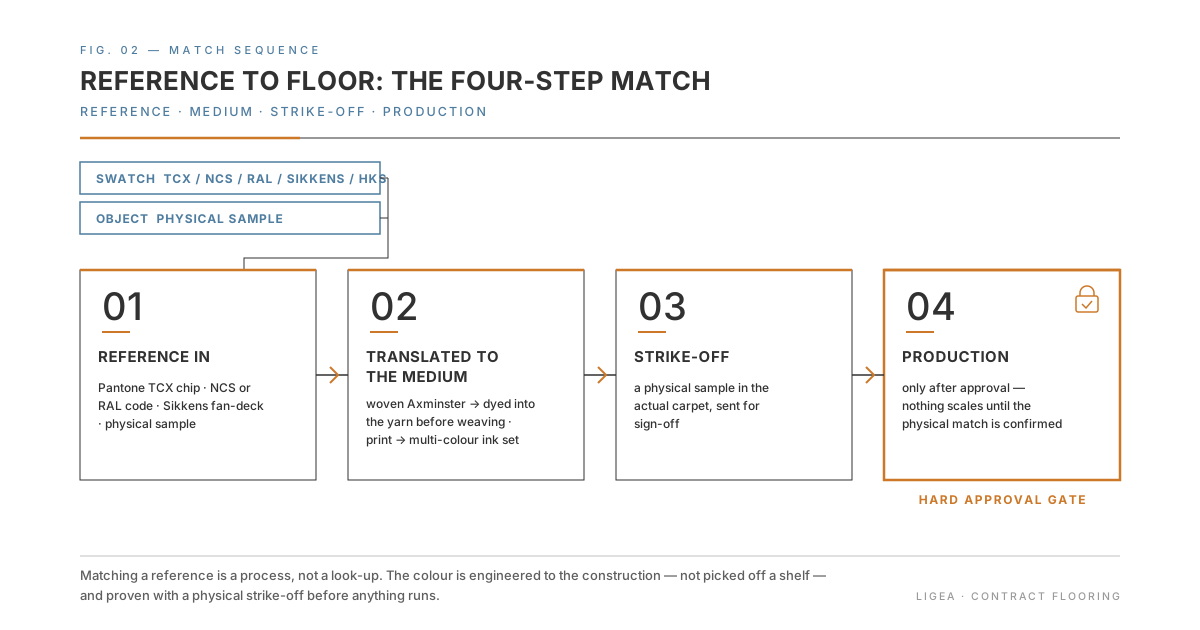
Matching a reference is a process, not a look-up:
- 1. Reference in. A Pantone TCX chip, an NCS or RAL code, a Sikkens fan-deck, or a physical sample.
- 2. Translated to the medium. For woven Axminster the colour is dyed into the yarn before weaving; for printed carpet it is mixed as a custom colour and reproduced on the print line — true-colour printing uses a multi-colour ink set of pre-mixed shades, not a basic four-ink process. Either way the colour is engineered to the construction — not picked off a shelf.
- 3. Strike-off. A physical sample in the actual carpet is produced and sent for sign-off.
- 4. Production only after approval. Nothing scales until the physical match is confirmed.
06The Traps That Make a Physical Strike-Off Non-Negotiable
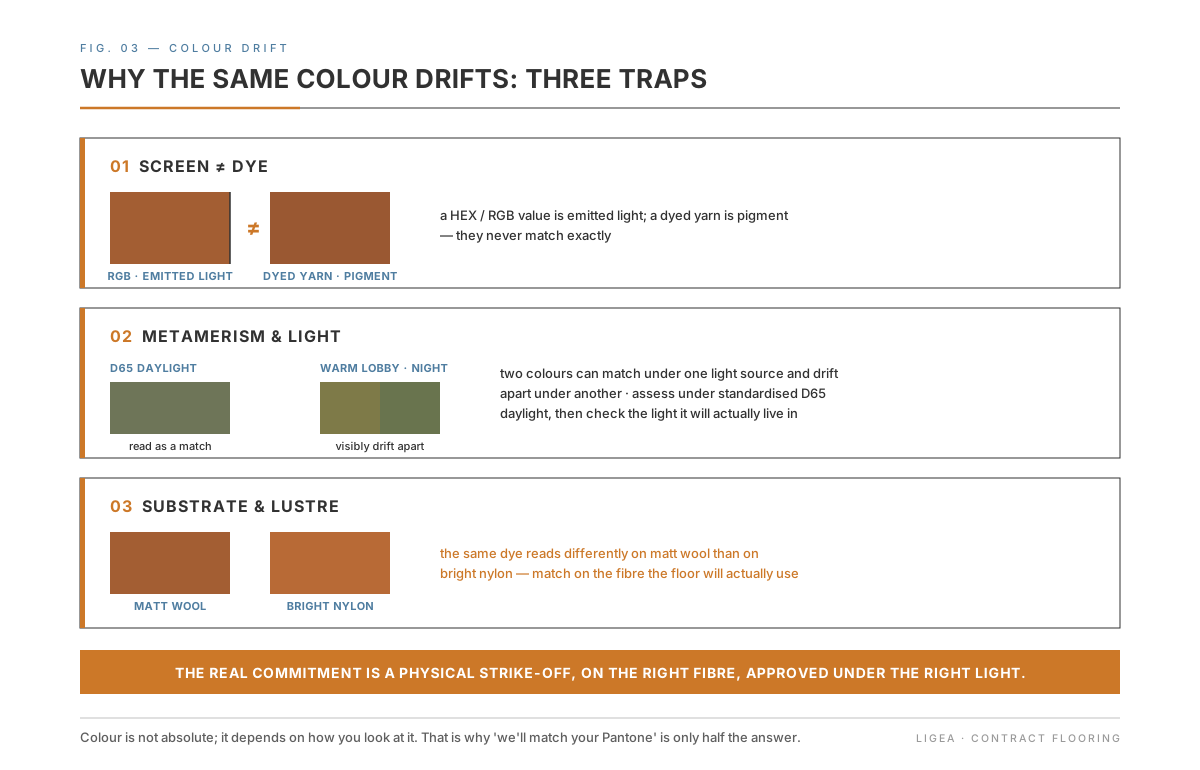
Colour is not absolute; it depends on how you look at it.
- Screen — and print proofs — ≠ dye. A HEX or RGB value on a monitor is emitted light; a four-ink value is only a print proof approximation. A dyed floor is neither: each colour is mixed as a bespoke dye recipe and applied to the yarn — or, on the print line, reproduced with a custom multi-ink set of pre-mixed shades — so neither a screen number nor a four-ink proof build is the colour model the carpet is actually made from. That gap is why a colour signed off on a monitor or a print proof can still disappoint underfoot.
- Metamerism and light. Two colours can match under one light source and drift apart under another. Serious matching is assessed under standardised lighting (D65 daylight) — and the floor should also be checked under the light it will actually live in. A warm lobby at night reads differently from a daylit atrium.
- Substrate and lustre. The same dye reads differently on matt wool than on bright nylon, so the match has to be made on the fibre the floor will actually use.
This is why "we'll match your Pantone" is only half the answer. The real commitment is a physical strike-off, on the right fibre, approved under the right light.
07After the Match: Tolerance and Fastness
A signed strike-off anchors the colour, but two things the eye alone can't settle are worth pinning down in the specification.
Set a tolerance, not just a target. No two dye lots are ever bit-for-bit identical, so in practice an experienced specifier agrees an acceptable margin up front rather than judging each run by eye. Colour scientists express that margin as a colour difference, or ΔE — the measured distance between two colours in a defined colour space: the smaller the number, the closer the match. Naming a tolerance turns "near enough" from an argument into a figure both sides can measure.
Specify how the colour holds, not just how it starts. A hospitality floor lives for years under daylight and lamplight, and a colour that matches perfectly on day one is only worth specifying if it stays put. The textile benchmark is colour fastness to artificial light, rated on the blue wool scale from 1 to 8 — the higher the number, the more fade-resistant the colour. For sun-drenched lobbies and atria, specifiers often call for a minimum rating rather than leaving fade resistance to chance.
08Bring Any Reference, Not a Palette Number
This is where it pays not to be tied to a stock range. We don't hand you a palette box and ask you to find the nearest shade. Bring the colour the scheme is built on — Pantone TCX, NCS, RAL, Sikkens, HKS, or a physical object — and we engineer it into the carpet, woven or printed, and prove it with a physical strike-off before anything runs. The colour serves the design, not the other way round.
---
ligea engineers contract surfaces for hospitality projects worldwide — matched to your colour, your construction and your budget. If you're holding a reference the supplier palette can't quite hit, see our surfaces or book a 15-minute spec call.