
Broadloom vs Carpet Tiles in Hotels: A Format Decision Guide
A buyer's guide to broadloom versus carpet tiles in hotels — install waste, seams, design continuity, replacement, moisture and acoustics, and where each format genuinely wins.
The format question arrives before the colour, the pattern or even the fibre: does this floor go down as a roll or as a grid of squares? It sounds like an installer's detail, but the broadloom-versus-tile decision quietly sets your install waste, how seams read in raking light, what a stain repair costs at 2am, and whether a refurbished corridor can stay open while the work happens. The received wisdom — broadloom for seamless luxury, tiles for modular convenience — is broadly right and quietly incomplete. Here is what actually separates the two formats, with the numbers a specifier can defend.
01Installation Waste: The Headline Number Most Briefs Ignore
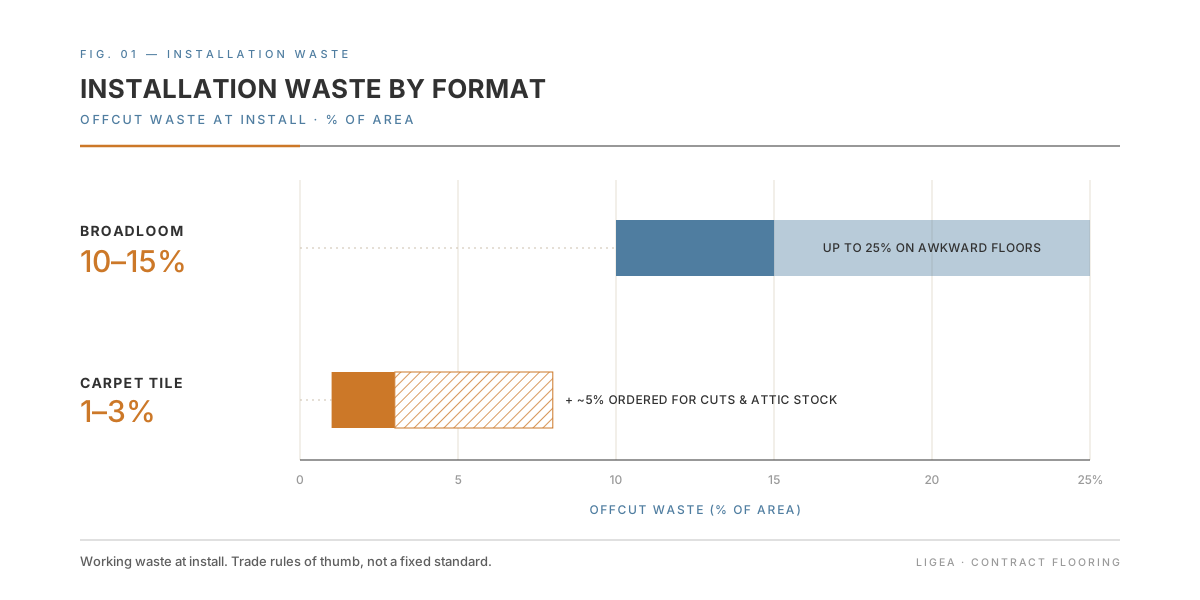
The clearest, most quantifiable gap between the two formats is offcut waste at install. Broadloom is cut from rolls to fit the room, and the drops, odd angles and pattern alignment generate a working waste figure commonly cited at 10–15%, rising toward 25% on geometrically awkward floors — partly from cutting to fit, and partly because rooms wider than the roll force fill strips. Carpet tile, cut far less, is often cited at only 1–5% offcut waste, though estimators still typically order around 5% extra to cover cuts, mistakes and attic stock. These are widely repeated trade rules of thumb rather than figures fixed by an installation standard.
Patterned broadloom makes this worse before it makes it better. To keep a pattern continuous, the design has to align across the seam — the US commercial installation standard (CRI 104) requires the pattern to be matched at the midpoint of the seam and worked toward the ends — which means ordering extra material purely to absorb the repeat (Carpet & Rug Institute). There is a second-order point worth carrying into a sustainability conversation: tile offcuts are smaller and easier to handle, and uplifted broadloom in particular tends to come up carrying adhesive and patch residue that complicates recycling. Fresh installation drops are comparatively clean; the contamination problem is most acute at end of life. If a project is chasing a diversion-from-landfill target, format choice is part of that maths, not separate from it.
02Seams and Design Continuity: Where the Eye Decides
This is the heart of the format debate, and it is mostly about what the guest sees. Broadloom rolls are typically 12 ft (3.66 m) wide, with 13'2" and 15' goods also available, so a corridor or guestroom narrower than the roll runs with very few seams. Those seams are not welded, though — broadloom is joined with hot-melt seam tape activated by a heated seaming iron, an adhesive bond between the carpet backings, not a fusing of the carpet faces. A skilled installer places and disguises seams (orienting them with the light and traffic, away from focal points) rather than making them truly invisible; the industry's own position is that a seam is never 100% invisible (Carpet & Rug Institute, CRI 105). That is the "seamless luxury" the trade talks about — really fewer and well-placed seams, not zero. A large ballroom still has joins, just discreet ones.
Tiles are candid about their own limitation. Manufacturers' own tile installation guides note that tile seams are never fully invisible — typically most noticeable on the day of install, then less noticeable with vacuuming and foot traffic (Construction Specifier). Standard formats run 18"×18" (457 mm), 24"×24" and 25×100 cm planks (the 50×50 cm square is the most common globally). The real divider is pattern scale: broadloom carries large-scale mosaics, florals, directional corridor runs and brand-bespoke artwork continuously; tiles favour smaller geometric and abstract repeats and can show a grid in long sightlines.
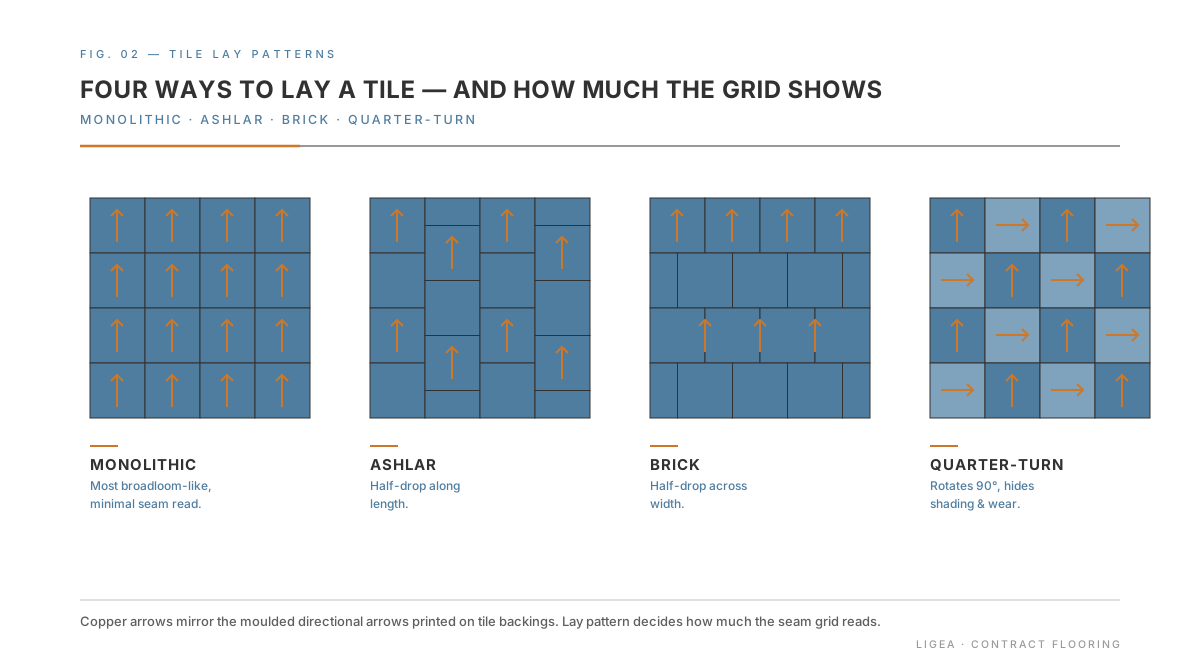
There is specifier vocabulary that decides how much that grid reads, and it belongs in the conversation with the installer: monolithic lay (all directional arrows the same way) is the most broadloom-like and minimises the seam read; ashlar and brick offset tiles by half a tile (ashlar along the length, brick across the width); quarter-turn rotates each tile 90° from its neighbour to disguise shading and wear. Some tile constructions have only one or two approved layouts, and choosing the wrong one produces a visibly poor seam appearance — which is why manufacturers print directional arrows on the tile backs. On the broadloom side the equivalent discipline is having the mill check a seam and placement plan before install: seam direction and location are easy to get wrong and expensive to fix.
03Replacement and Downtime: The Cleanest Case for Tile
If there is one axis where practitioners do not argue, it is repair. A stained or damaged tile is swapped individually in minutes, from spares stored flat on site, with the space staying largely operational. Broadloom repair is genuinely difficult and costly — often a re-lay of the affected run — and the patch tends to show, because surrounding carpet has faded and worn while the spare sat pristine in storage. For food and beverage, banquet and gaming floors, where spills are routine, that single property frequently decides the format on its own.
This connects directly to a number every hospitality brief should carry: attic stock, the spare material ordered alongside the main run. There is no single universal figure, but a common convention is around 5% of installed area for minor accidents, rising to as much as 20% when an owner is deliberately planning selective replacement over a ten-year horizon instead of one disruptive full re-lay. For a phased renovation with occupied rooms, that higher attic-stock figure is exactly the lever that lets a property refresh itself in pieces — and modular tile is what makes the lever cheap to pull.
One field caveat the vendor literature underplays: in service corridors with rolling housekeeping and luggage carts, broadloom seams can wear at the edge and need re-seaming, which is why some specifiers reach for tile in back-of-house even when broadloom rules the guest corridors.
04Subfloor Moisture and Acoustics: Two Quiet Technical Trade-offs
Two less-discussed factors often break a tie. The first is moisture. Carpet over a concrete slab has to respect the slab's relative humidity, measured by in-situ probe to ASTM F2170. Broadloom with synthetic latex backing is generally held to a maximum around 80–85% RH, while many modular tiles on thermoplastic or PVC backing are rated up to roughly 90% RH — so tile tolerates a marginally damper slab. That tolerance is real but not a licence to skip testing; mould risk in carpet rises sharply above 85% RH, and the only safe number is the one on the specific adhesive and backing datasheet. Worth flagging the opposite failure mode too: tile edge-curling in hotels is most often slab moisture and aggressive cleaning interacting, not traffic wear — which is why housekeeping method (some tile warranties restrict hot-water extraction and rotary machines) matters more than it looks.
The second is acoustics and underfoot comfort, where broadloom keeps an edge. Hospitality typically targets an impact rating of IIC 55–60 for guest comfort; a concrete slab with carpet can reach IIC 65–75, and carpet over a separate cushion adds the most impact dampening (CRI Acoustical Bulletin). Broadloom takes a separate, thicker underlay, producing the plush "sink-in" feel guests read as quality; tiles need a stiffer attached backing for dimensional stability, so they sit thinner and firmer underfoot. Cushion-backed tiles narrow the gap but rarely match a dedicated broadloom pad — a genuine differentiator for guestrooms.
05The Cost Myth, and Where Each Format Wins
The most useful thing a buyer can know is that the common assumption is backwards. Tiles are not the budget option on first cost: installed, carpet tile typically carries a higher first cost than broadloom, with tile labour higher too. Tile's savings are downstream — in waste, in replacement events, in downtime avoided — not in the purchase order. Judged on total cost of ownership, swapping ten squares to make a lobby look new beats re-rolling a whole corridor; judged on day one, broadloom is often cheaper.
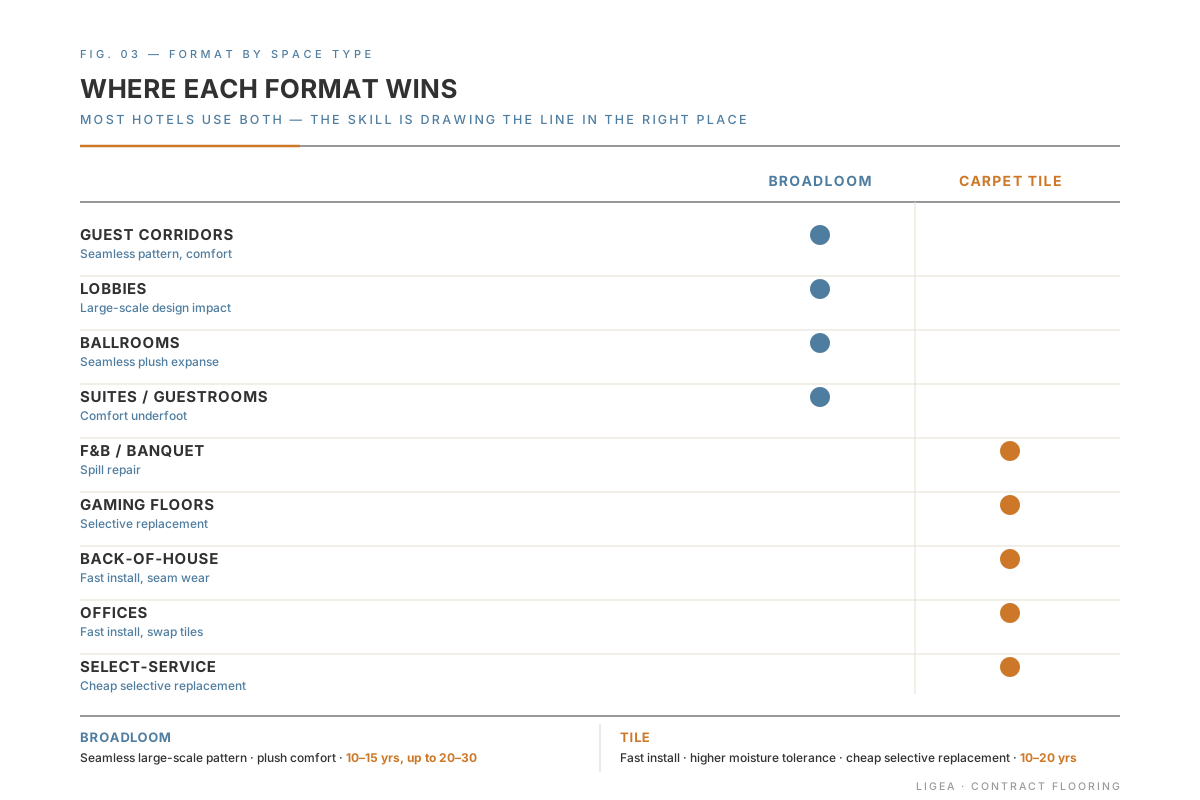
So the honest verdict is a split, not a winner. Woven broadloom holds the signature high-traffic public spaces — guest corridors, lobbies, ballrooms, suites — where seamless large-scale pattern and plush comfort define the brand, and where well-built woven constructions are routinely credited with a 15–25-year physical life, toward 30 at the top end — though in branded hotels the 5–7-year soft-goods cycle usually calls time first. High-specification tile, rated 10–20 years, wins back-of-house, offices, select-service, gaming floors, and anywhere fast install, higher moisture tolerance and cheap selective replacement matter more than an unbroken pattern. Most hotels, in practice, use both — and the skill is drawing the line in the right place.
06Where ligea Comes In
A format decision is rarely just a format decision — it is a designer's vision, an operator's budget and a specific pattern of traffic, light and moisture, all arguing at once. Our role is to read all three and translate them into the right construction, then deliver that construction in whichever format the space actually needs. The same design can leave us as broadloom rolls (3.66 / 4 m), cut-and-bound rugs, or modular tiles, so the guest corridor and the back-of-house can share a visual language while each gets the format that serves it. And because bespoke design is our default rather than the exception, that extends to the tile format too: custom-patterned tiles are unusual in a category built around stock catalogues you normally have to dig through — we can produce them, though tile economics mean they carry comparatively high minimum order quantities, which we name up front rather than after sign-off.
For the signature spaces where seamless large-scale pattern and comfort carry the brand, we specify woven Axminster in 80/20 wool-nylon or 100% wool, built to a defined pitch and rows — from guestroom weights up to airport-grade density, in up to sixteen colours, with matt-and-gloss zoning, refined edge binding, an IMO-marine version, and constructions reaching EN 13501-1 Bfl-s1. Where a scheme lives on gradient, photographic detail or a very wide colour range, we move to printed 100% nylon, working from pre-mixed colours with no pattern-repeat limit. Because we work across multiple producers rather than a single loom or print line, the brief picks the construction, the format and the maker — not the other way round. Custom colour is matched to Pantone TCX, NCS, RAL or a physical sample and proven on a physical strike-off, with bulk lead times typically two to four weeks for print and three to eight for Axminster after sign-off, and AI-assisted rendering compressing the approval rounds that usually slow a project down.
---
ligea engineers contract surfaces for hospitality projects worldwide — matched to your design, your construction and your budget, in broadloom or tile. See our surfaces or book a 15-minute spec call.