
Ballroom and Event-Space Carpet: Specifying for Scale, Load and Turnaround
A buyer's guide to ballroom and event-space carpet — pattern scale and seam planning, rolling-load resistance, fast-turnaround cleaning, statement design and fire class, with the real numbers.
A ballroom floor has to do something almost no other surface in a building is asked to do: read as one continuous, deliberate design across hundreds — sometimes a couple of thousand — square metres, while surviving banquet trolleys, staging dollies, spilled wine and a turnaround crew that needs the room reset before the next event load-in. It is the largest single carpet decision most hospitality projects make, and it is the one where a swatch-board choice most often comes apart at room scale. This guide walks through the five gates that actually decide whether an event-space floor still earns its keep in year five — pattern and seams, rolling load, cleaning, statement design and fire — with the real numbers behind each.
011. Pattern Scale and Seam Matching: The Most Misjudged Spec
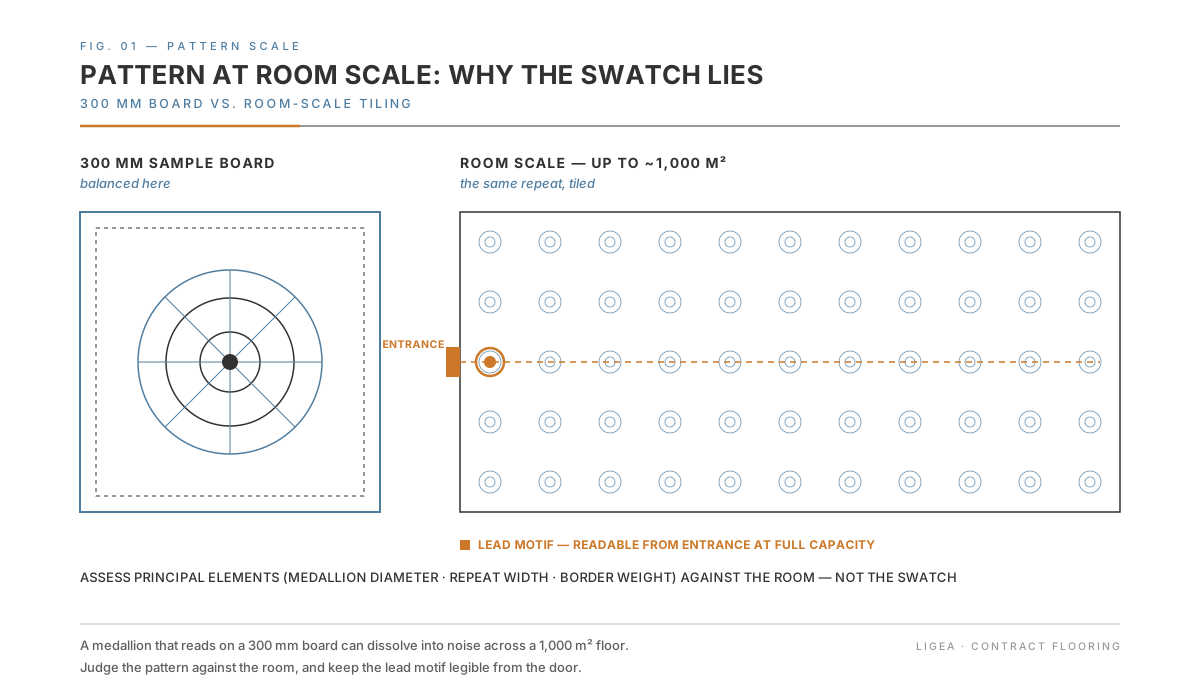
The single most common ballroom mistake is judging pattern off a 300 mm sample board. A medallion or geometric repeat that looks balanced on a swatch can vanish into visual noise — or read as chaos — once it is tiled across a 1,000 m² floor. The discipline to apply is to assess the principal elements (medallion diameter, repeat width, border weight) against the actual room dimensions, not the sample, and to ensure the lead motif stays readable from the room entrance at full capacity.
Seams are the second half of the same problem, and they have to be planned before production, not improvised on site. Industry installation practice is explicit that seam positions and laying direction should be planned off the floor plan during the design stage, so that seams fall under table positions or in low-visibility service aisles and the pattern keeps flowing across the run — the CRI 104 commercial-carpet installation standard is the usual reference point for sequencing and seam method. A practitioner rule that holds up across estimator communities: start a full-width run at the main entrance and bleed off toward the back of the room — put perfect alignment where guests see it, hide the transitions where they don't.
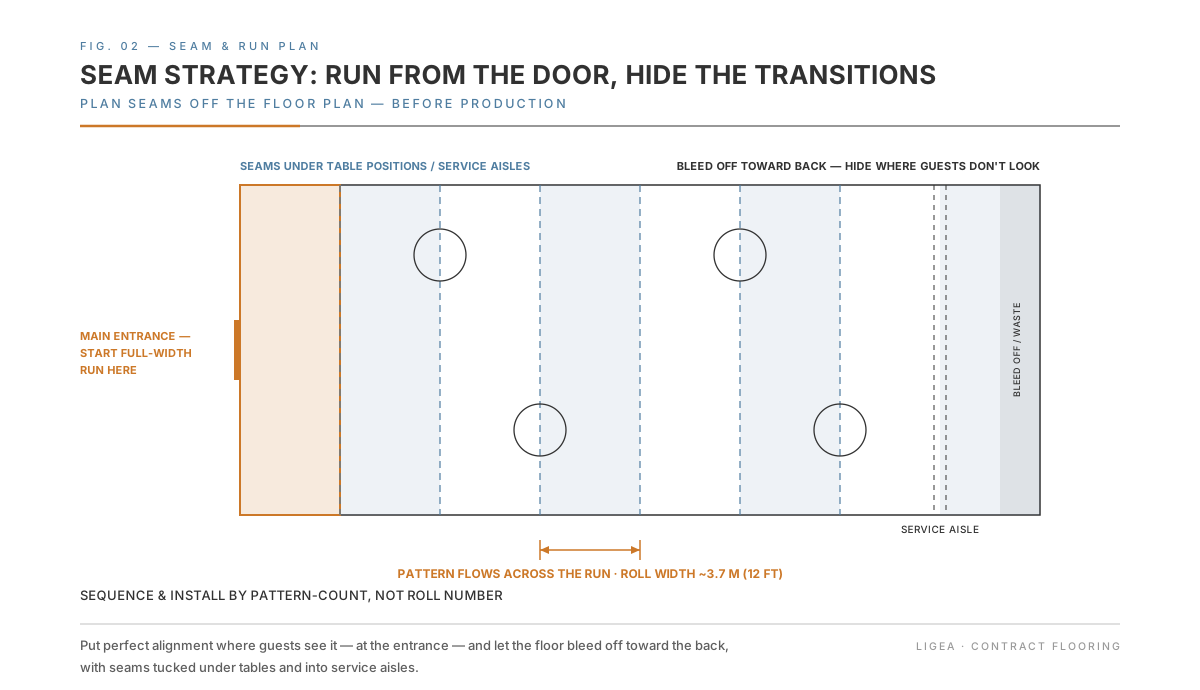
Installers also have to absorb manufacturing tolerances that the industry treats as normal, not defective. Crucially, there is no single industry standard governing pattern variation — bow, skew, elongation and trueness of edge are treated as normal processing variation, and each carpet maker publishes its own tolerances. As a practitioner rule of thumb (a convention, not a codified standard), bow and skew commonly run up to about 38 mm across a 3.7 m width (1½ in across 12 ft), and lengthwise pattern elongation up to about 50 mm in 3.7 m (2 in in 12 ft) within one dye lot. Patterned goods must be sequenced and installed by pattern-count measurement, not by roll number. The budget consequence is real: directional and patterned carpet needs material added for alignment, and on large ballrooms practitioner accounts report waste landing in the 30–35% range — occasionally far higher on awkward room shapes. Ordering short on a large repeat risks a dye-lot mismatch on the reorder, which is why event floors are specified generously from the start.
022. Rolling-Load Resistance: It's the Installation, Not Just the Carpet
Ballrooms live under wheels — banquet carts, table dollies, staging platforms, AV flight cases. The relevant test is ISO 4918, the castor-chair test (which replaced the withdrawn EN 425), where a loaded rolling castor is run over the floor and appearance is assessed after thousands of cycles to gauge resistance to delamination and structural breakdown. The specification language designers should require alongside it comes from EN 985, which rates carpet for "occasional" versus "intensive" castor-chair use — for an event floor, intensive is the only honest answer.
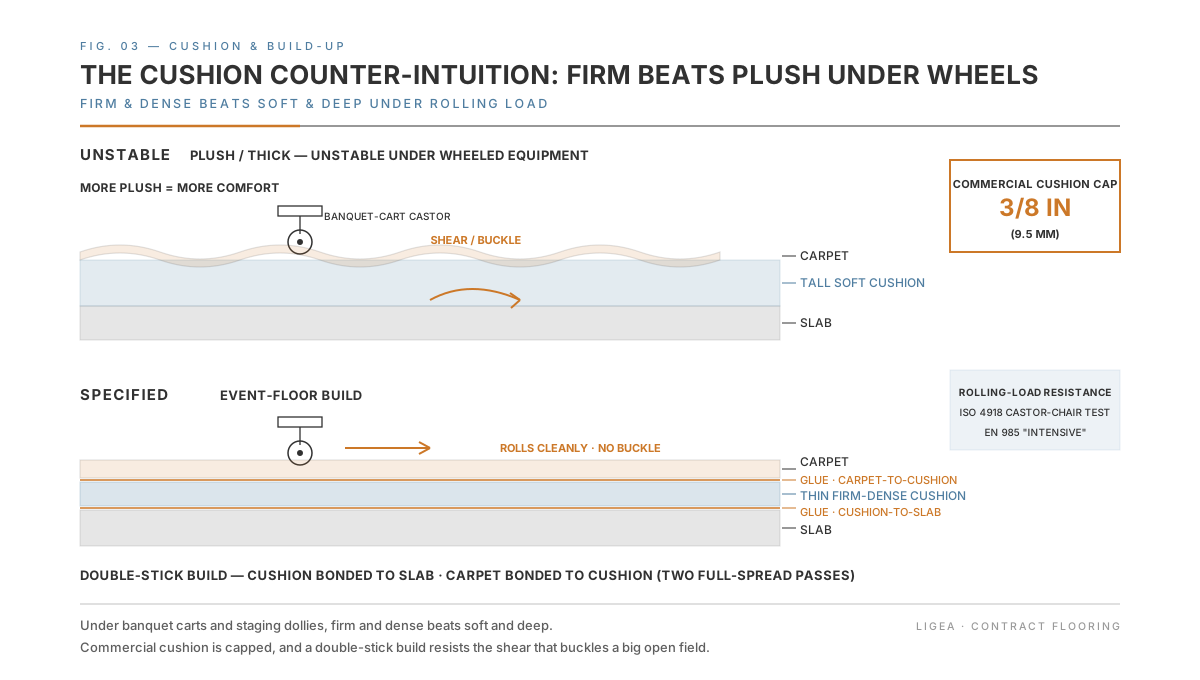
But the construction is only half the defence; the assembly under it is the other half. For heavy rolling zones, industry installation guidance favours a double-stick (double-glue) build — cushion bonded to the slab and carpet bonded to the cushion in two full-spread adhesive passes — to resist the shear forces that otherwise stretch and buckle a large open field, the method set out in the industry installation guidelines for commercial carpet and bonded cushion. And here a popular intuition is simply wrong: thicker, plusher cushion is worse, not better, under rolling load. The Carpet Cushion Council's commercial guidelines cap commercial cushion thickness at 9.5 mm (3/8 in), because anything thicker becomes unstable under wheeled equipment. For ballrooms, firm and dense beats soft and deep every time.
One caveat that catches out big open fields: natural-fibre (wool) broadloom is dimensionally unstable until its adhesive sets, so installation guidance calls for keeping the room climate-controlled — typically 18–35 °C (65–95 °F) and up to 65% relative humidity, held for at least 48 hours before and 72 hours after laying, since humidity makes wool expand and contract before the bond cures, conditions specified in the CRI 104 commercial-carpet installation standard. There is also a construction argument to weigh: woven carpet anchors its pile into the backing in a single weaving operation, so there is no adhesive bond for chair-dragging and rolling equipment to test in the first place. On tufted goods that bond can delaminate, but with quality latex and proper curing it is largely a cheap-production and ageing issue today rather than an inevitability under rolling load.
033. Stain and Quick-Turnaround Cleaning
Event venues run multiple functions in short windows, so the binding constraint is often drying time, not cleaning power. Fast-dry and encapsulation methods are favoured precisely because they avoid the wet downtime that would otherwise block the next load-in. But the highest-leverage maintenance decision happens at the threshold, not on the floor. ISSA-derived guidance holds that a walk-off matting zone of roughly 4.5 to 7.5 metres (15 to 25 ft) at entries can trap up to around 90% of the soil that would otherwise be tracked across a venue, and soil is expensive once it's inside — the same body of guidance puts the cost of removing tracked-in dirt at many times the cost of stopping it at the threshold and, citing a Swiss study, estimates savings of as much as 67% on overall floor-care costs simply from trapping soil at the door.
It is worth being honest about fibre, because two myths drive bad ballroom decisions. First, appearance retention is engineered into the carpet — through colour, pattern, density and fibre — and then maintained; it is not something a cleaning crew can fully restore after the fact, a distinction the CRI carpet maintenance and troubleshooting bulletin underlines. That is the practical reason ballrooms almost never use plain, light carpet: a patterned, mid-tone or multi-colour field hides spills and soil between deep cleans. Second, wool is not stain-proof. Its scales repel dry dirt well, but the fibre absorbs liquids — wine, coffee — readily, and solution-dyed nylon is widely held to outperform wool on liquid stains in food-and-beverage-heavy spaces. The familiar "80/20 wool-nylon is always more durable" assumption is also increasingly contested in trade testing, which is reason to specify the blend on the merits of a given room rather than as a reflex.
044. Statement Design Without Sabotaging Practicality
A ballroom floor is brand real estate, and the design format that supports the most ambitious work is woven Axminster, whose modern power looms can weave many colours and patterns in a single design — commonly cited in the trade as up to around 16 colours, enough for intricate medallions, borders and brand motifs, with repeats available in virtually any width or length. For logo or crest inlays, choose colours that contrast the surrounding field for legibility, and simplify complex marks to clean vectors so they cut and reseam cleanly.
The core tension never goes away: a large medallion has to be legible across the room, yet the repeat has to stay small enough to seam cleanly and hide soil between cleans. There is also a design-school argument for keeping carpet in the room at all, beyond looks — acoustic guidance puts typical broadloom at a noise reduction coefficient around 0.35, rising with pile depth and underlay, which pulls down the long reverberation times and footfall noise that plague large hard-floored assembly rooms during crowd build-up. Two things designers consistently underestimate. One is pile reversal — "watermarking" or "pooling" — random light-and-dark patches that appear in very large fields like ballrooms, look like a spill from one angle and normal from another, and are permanent; as the CRI technical bulletin on pile reversal and shading makes clear, it is not a manufacturing defect and cannot be reversed — a documented no-defect disclaimer item, not a fault. The other is the dance floor itself — you cannot dance on carpet, so event spaces almost always need a portable hard floor dropped over the carpet, which is worth designing for rather than discovering on the day.
055. Fire: Specify the System, Not Just the Face
Ballrooms are assembly occupancies, and the governing North American test is ASTM E648 / NFPA 253, which measures critical radiant flux: Class I requires ≥0.45 W/cm² and Class II sits at 0.22–0.44 W/cm². An important nuance often missed: the radiant-panel test addresses corridors and exit-access routes rather than open rooms, so it is typically a ballroom's connecting corridors and egress paths where Class I is mandated, even when the open field itself is not directly governed — but the safe specification posture is to verify the system as installed (carpet plus backing and adhesive), not just the face yarn. On the European side, EN 13501-1 sorts flooring by reaction to fire, with classes such as Bfl-s1 and Cfl-s1 describing flame-retardant flooring with low smoke — and many hotels and public assembly venues require at least Cfl-s1 — layered on top of an EN 1307 durability class, with Class 33 (heavy commercial) being the lobby and ballroom tier.
Fibre choice carries a genuine fire argument here. Wool's ignition temperature sits around 570–600 °C, well above many synthetics; wool chars and tends to self-extinguish, forming an insulating char, and crucially does not melt or drip the way synthetics can — a real consideration in a public assembly space, as the IWTO factsheet on wool and flame resistance documents. It is one of the few places where the design-led material and the safety-led material point the same direction.
06Where ligea Comes In
Most of the above is industry truth that applies whoever you buy from. What we do is sit between the three parties who usually pull in different directions — the designer with a vision, the developer with a budget, and the producer with a loom or a print line — and make the floor land for all of them.
We read the designer's intent first: whether the room wants the colour depth and crisp motif of woven Axminster (specified by pitch × rows, from lighter constructions up to roughly 1,880 g/m² at the heaviest, up to 16 colours, with an IMO marine version and EN 13501-1 Bfl-s1 reach where the brief demands it), or the gradient and photographic freedom of continuous-tone printed nylon, where the colour range is very wide (pre-mixed shades) and approval is faster, with an honest sharpness-versus-pile trade-off we'll name up front. We work to the developer's number by matching the brief to the right construction and the right producer — we are not tied to a single loom or print line — and supply the same design as broadloom roll, cut-and-bound rug or modular tile as the room and the rolling loads require. Colour is matched to your Pantone TCX, NCS, RAL or a physical sample via a real strike-off, so the medallion you sign off is the medallion that ships. AI-assisted rendering compresses the approval rounds, and bulk lead times run roughly two to four weeks for print and three to eight for Axminster once design, colour, strike-off and mockup are signed — measured against an event calendar that rarely waits.
See how we specify event-space floors at ligea.com/surfaces, or bring us your ballroom brief at ligea.com/contact.