
TARR, Crowns and Traffic Classes: Decoding the Hospitality Carpet Label
What the numbers on a hospitality carpet label actually mean — EN 1307 use class 31/32/33, the LC1–LC5 luxury crowns, and TARR appearance-retention ratings — and which values to specify for each hotel zone.
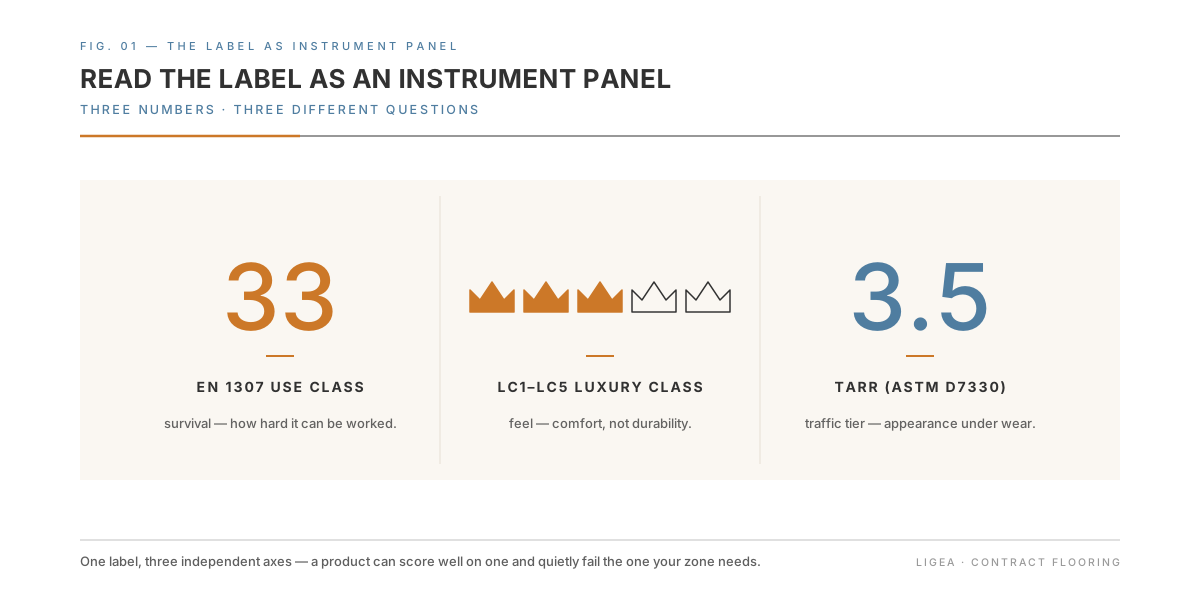
Turn over a contract carpet sample and the label reads like a dashboard: a number like 33, a little row of crowns, sometimes a decimal such as 3.5, and a scatter of standards codes. Most specifiers learn to glance at the big number and move on — "33 is the good one" — and leave the rest as background noise. That instinct is half right and half dangerous. The big number, the crowns and the decimal each measure a different thing, and a product can score well on one while quietly failing the one your project actually needs. This guide decodes the three values that decide whether a hospitality floor still looks specified in year five — and tells you which to demand for each zone.
01Two Systems, One Label
The first source of confusion is that the label is usually carrying two classification systems at once — a European one and a North American one — that overlap without being identical.
In Europe and most of the international hospitality market, the governing document is EN 1307 (harmonised internationally as ISO 10874). It sorts textile floor coverings into use classes by tested performance — appearance retention, abrasion, structural integrity — rather than by any single headline figure. In North America, the parallel framework is the Carpet and Rug Institute's TARR system, which expresses durability as a decimal score against expected traffic. A premium contract product made for a global hospitality market will often print both. Read them as two lenses on the same question — how hard can this floor be worked before it stops looking right — not as interchangeable numbers.
02The Big Number: EN 1307 Use Class 31, 32, 33
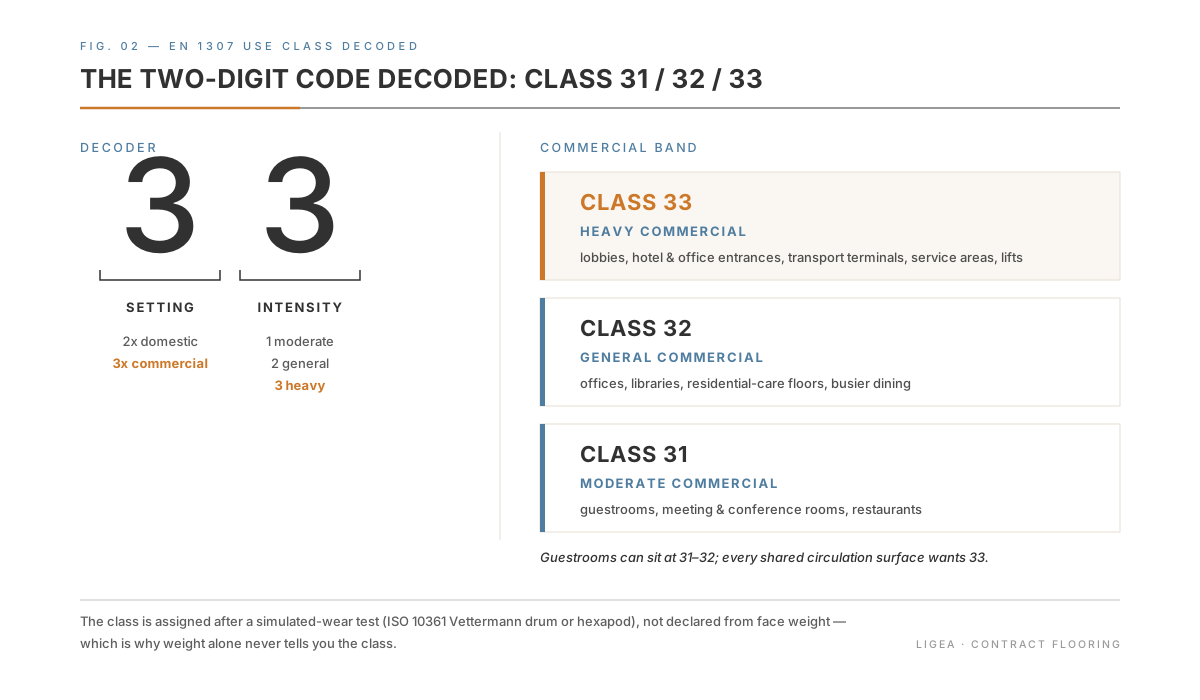
The headline figure is the use class, and its logic is simple once you see the two digits separately. The first digit is the setting: 2x = domestic, 3x = commercial. The second digit is the intensity: 1 = moderate, 2 = general, 3 = heavy. So the commercial band runs Class 31 (moderate commercial), Class 32 (general commercial) and Class 33 (heavy commercial) — with Class 33 the top commercial tier.
The standard even attaches example locations, which map almost directly onto a hotel:
- Class 31 — moderate commercial: guestrooms, meeting and conference rooms, restaurants, places of worship.
- Class 32 — general commercial: offices, libraries, residential-care floors, busier dining.
- Class 33 — heavy commercial: lobbies, hotel and office entrances, transport terminals, service areas and lifts.
The practical reading for a hotel is that guestrooms can legitimately sit at Class 31–32, while every shared circulation surface — corridors, lobby, reception, lifts — wants Class 33. Specifying one blanket class for the whole property either over-builds the bedrooms or under-builds the corridors; the use class is meant to be zoned, not flattened.
What gives the number its teeth is how it is earned. The class is not a manufacturer's self-declaration of weight — it is assigned after a simulated-wear test. Under ISO 10361, a specimen is fatigued in a Vettermann drum (a studded steel ball tumbling against the pile) or a hexapod tumbler, then the change in surface appearance is graded against a reference scale, and that graded result drives the use class. In other words, EN 1307 is fundamentally an appearance-retention classification with abrasion and integrity checks layered on — which is exactly why face weight alone never tells you the class.
03The Crowns: LC1–LC5 Is Comfort, Not Durability
Next to the use class sits a second mark that trips up more specs than any other: a Luxury Classification from LC1 to LC5, often printed as a row of crowns — one crown for LC1, five for LC5.
The single most useful thing to understand is that the crowns do not measure durability at all. The Luxury Use Class runs LC1 (lowest) to LC5 (highest) and is assigned alongside — but independently of — the use class; it describes comfort, the plushness, density and underfoot feel of the construction, derived from physical parameters such as total and pile mass, pile and total thickness, tuft count and pile density. A higher LC means a richer, softer, more substantial-feeling carpet — not a harder-wearing one.
This is the trap. A carpet can be Class 33 with only LC2 crowns, or LC4 with a use class of 31. The two axes are genuinely independent: one answers "how much punishment can it take," the other "how luxurious does it feel." A boutique suite might prioritise high crowns at a modest use class; a high-traffic lobby in a five-star property usually wants both — Class 33 for survival and LC4–LC5 for the feel the brand is paying for. Reading the crowns as a durability grade is how a beautiful, plush, expensive carpet ends up crushed flat in a corridor it was never built to survive.
04The Decimal: TARR and What "3.5" Means
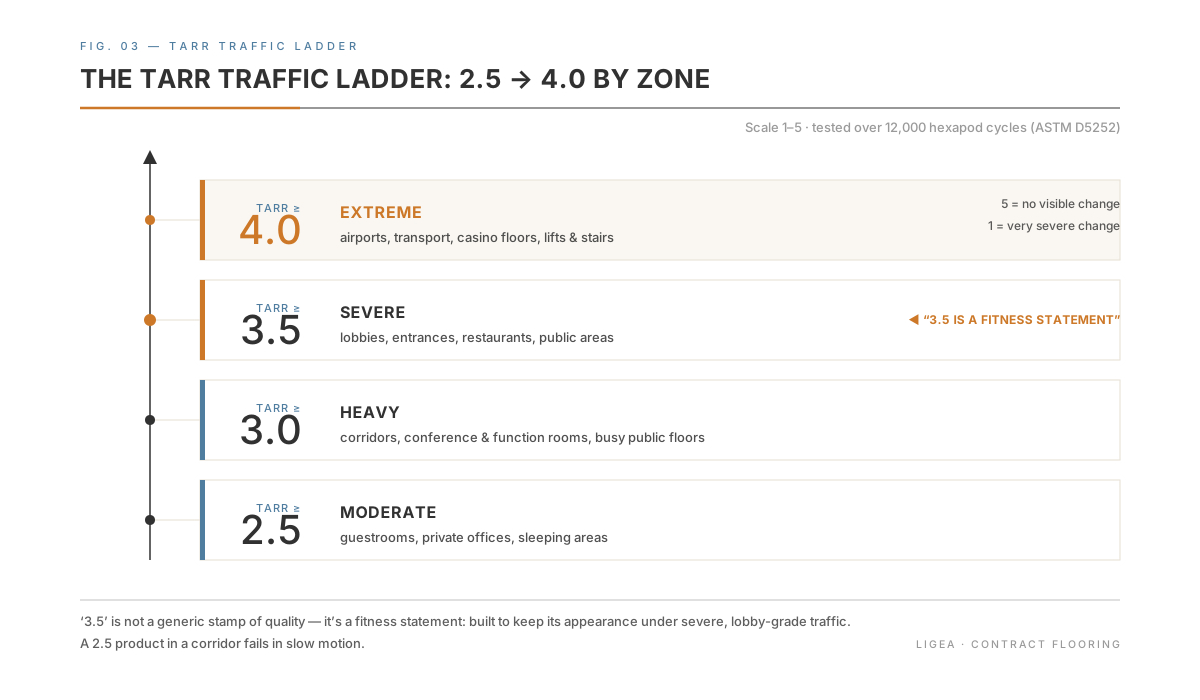
The North American label adds a different number: the Texture Appearance Retention Rating (TARR), the CRI's measure of how well a pile holds its look under wear. It is reported on a 1-to-5 scale under ASTM D7330, where 5 means no visible change after testing and 1 means very severe change.
The test method matters because it is the same family of wear simulation as the European side: a specimen rides a hexapod tumble-drum tester (ASTM D5252) for 12,000 cycles, after which an assessor grades pile crush, pilling, matting and broken ends against standard reference scales. It is, in effect, the American cousin of the Vettermann/hexapod assessment behind an EN 1307 class — which is why the two systems, while not formally convertible, tend to move together.
The thresholds are the part worth memorising, because they translate directly into traffic categories:
| TARR ≥ | Traffic category | Typical hospitality zones |
|---|---|---|
| 2.5 | Moderate | Guestrooms, private offices, sleeping areas |
| 3.0 | Heavy | Corridors, conference and function rooms, busy public floors |
| 3.5 | Severe | Lobbies, entrances, restaurants, public areas |
| 4.0 | Extreme | Airports, transport, casino floors, lifts and stairs |
So "3.5" is not a generic stamp of quality — it is a fitness statement: a carpet rated 3.5 is built to keep its appearance under severe, lobby-grade traffic. Putting a 2.5 product in a corridor isn't a code failure; it's a slow-motion one, the kind that looks fine at handover and tired at the first refurbishment review.
05Where the Numbers Stop Telling the Truth
Specifiers who have managed a property through its first few years tend to treat these ratings as a floor, not a guarantee — and the standards bodies and inspectors quietly agree.
The honest limitation is that a wear test cannot reproduce your traffic. Industry guidance acknowledges that footfall isn't uniform: heavy boots are not business shoes, and the concentrated rolling loads of a casino or airport — luggage wheels, carts, trolleys — are a different physics from a 12,000-cycle hexapod. That's exactly why the extreme tier exists as a category of its own. A practitioner caution worth carrying into every spec: experienced inspectors generally report that genuine manufacturing-defect failures are comparatively rare, and that most real-world disappointments trace back to subfloor conditions, installation quality and maintenance — variables no rating on the label can capture.
A second, quieter mismatch: the EN 1307 class and the TARR decimal both grade appearance retention, which is closely related to but not the same as raw abrasion life or crush recovery. The classification answers "will it still look right," not "how many fibres survive" — useful, but not a complete durability picture on its own. This is also where construction reasserts itself: density, stitch rate, fibre type and twist are what physically resist crushing under concentrated load, and the rating is downstream of those, not a substitute for reading them. Brand standards reflect this — major operators set their own construction minimums on top of the class. In practice, a nylon face weight in the region of 36 oz/yd² (≈ 1,220 g/m²) is commonly specified for high-traffic public areas and corridors — a practice level, not a codified minimum; the trade body's own guidance leans on pile density rather than face weight as the durability measure.
So the ratings are a filter, not a verdict. They remove products that clearly can't survive the zone — which is most of their value — but they don't promise that a qualifying product, badly installed over a poor subfloor and under-maintained, will reach year five.
06Reading the Whole Label, Zone by Zone
Put the three numbers together and a coherent spec falls out:
- Guestrooms — EN 1307 Class 31–32, TARR ≥ 2.5, crowns chosen for the feel the brand wants. This is the one zone where the luxury class can lead, because the traffic is genuinely moderate.
- Corridors and function rooms — Class 33, TARR ≥ 3.0, with density and stitch rate read alongside, because rolling luggage is concentrated load.
- Lobby, reception, restaurants — Class 33, TARR ≥ 3.5 (severe), and ideally high crowns too, because this is where durability and luxury both have to be true at once.
- Lifts, stairs, transport-style throughput — treat as extreme, TARR ≥ 4.0, and don't be seduced by a high crown count standing in for it.
The discipline is to stop reading any one number as "the quality," and to read the label as a small instrument panel: use class for survival, crowns for feel, TARR for the traffic tier — each confirmed against the specific zone, occupancy and code, never assumed.
07Where ligea Comes In
The reason these labels confuse even experienced specifiers is that no single number carries the whole truth, the two systems don't formally convert, and the values you actually need are zoned — different for a suite than a lobby than a lift. Holding all of that against a live brief, a brand standard and a budget is the work — and it's the work we take off the table.
At ligea we read the designer's vision and the developer's budget at the same time, then engineer the carpet to the right values per zone rather than forcing one product across the whole floor plate: heavy-commercial constructions where corridors and lobbies demand them, comfort-led builds where a suite calls for feel over throughput, and the appearance-retention and fire credentials the jurisdiction and operator require — confirmed on a physical strike-off before anything goes to bulk. Because we work across multiple producers and techniques — woven, printed, hand-tufted and braided — the spec is never bent to fit one loom's class ceiling or one print line's palette. AI-assisted rendering compresses the approval rounds, and bulk lead times typically run roughly two to eight weeks — print fastest, custom Axminster longer — once design, colour, strike-off and mock-up are signed off. You get a label you can defend in a procurement review — not a guess dressed up as a number.
Explore our surfaces and constructions, or talk to us about specifying a property zone by zone.